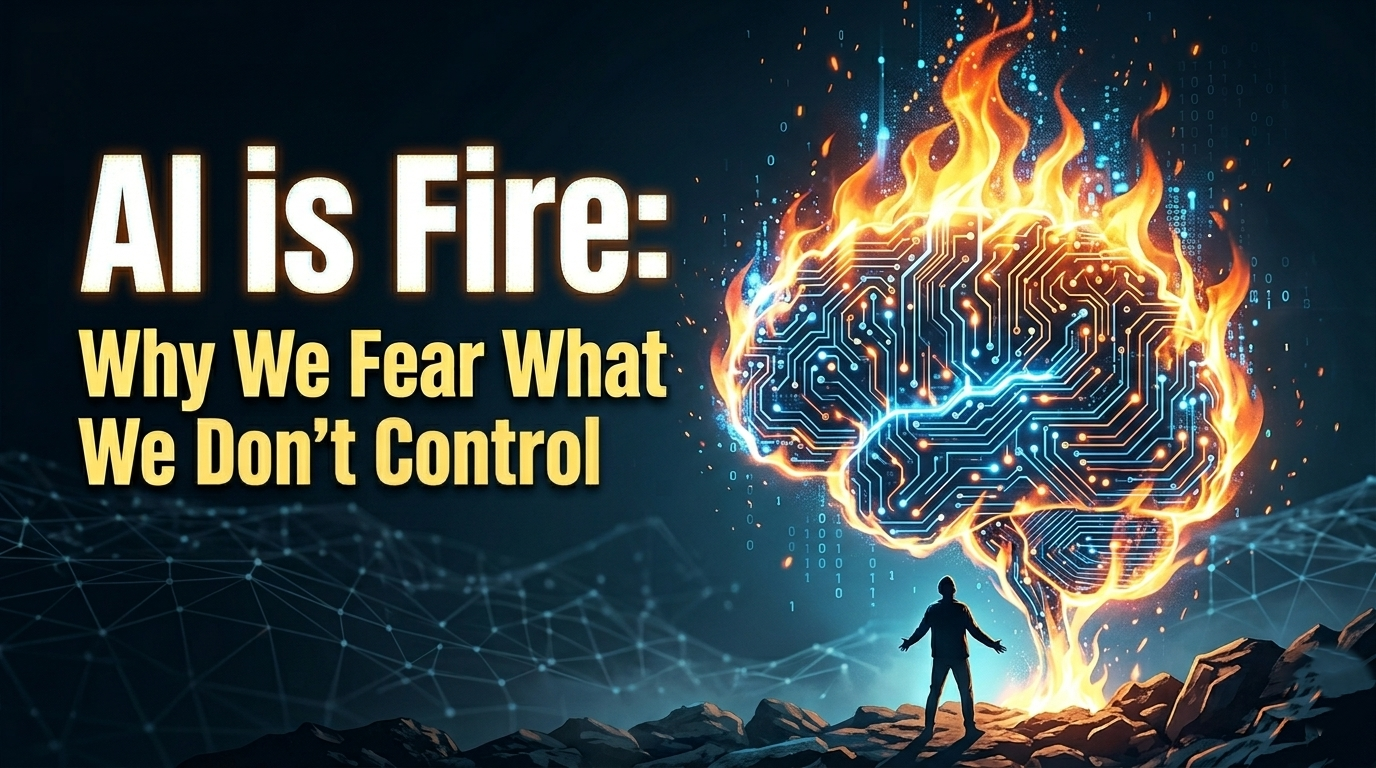
AI is Fire: Why We Fear What We Don't Control
Throughout human history, whenever we've discovered something fundamentally transformative, fear has been our first response. Not because the discovery itself was inherently evil, but because we didn't yet possess the wisdom to wield it responsibly. Artificial Intelligence is no exception—it's simply the latest chapter in humanity's eternal struggle with progress.
The Fire of Our Generation
Imagine standing in a prehistoric cave, watching humanity's first encounter with fire. The flames dance unpredictably, consuming what they touch—wood, shelter, sometimes flesh. Someone gets burned. Entire communities are destroyed. The elders gather and conclude: fire is dangerous, fire is destruction, fire must be feared and avoided.
They were right to be afraid. But they would have been profoundly wrong to reject it entirely.
Fire, like artificial intelligence, is a fundamentally dual-natured force. The same element that can destroy a village can cook food that sustains life. The same heat that burns can warm the cold and drive away darkness. The difference between catastrophe and civilization wasn't the discovery of fire itself—it was humanity's gradual understanding of *when*, *where*, and *how* to use it.
The Pattern of Human Discovery
This isn't unique to fire. Every major technological leap has followed the same trajectory:
The Printing Press — Initially feared by the Catholic Church as a tool that would spread dangerous ideas and undermine authority. Wasn't it right to be concerned? Yes. Was the solution to reject the technology? No.
Electricity — People died. Cities caught fire. Insurance companies refused to cover it. Yet humanity didn't conclude electricity was too dangerous to exist; we learned to respect it, to build safeguards around it, and eventually to make it serve us.
The Automobile — In early 1900s, thousands died annually in car accidents. Should we have stopped driving? Instead, we invented traffic laws, safety features, licensing requirements, and infrastructure.
The Internet — We were right to fear its dangers: misinformation, crime, exploitation, invasion of privacy. But the answer wasn't to ban it; it was to learn governance, to build platforms responsibly, and to educate users.
The pattern is clear: fear is wisdom in the face of the unknown, but rejecting something unknown is cowardice.
Why AI Terrifies Us (And Why That's Not Entirely Bad)
AI is genuinely powerful in ways we don't fully understand. It can generate, manipulate, and make decisions at scales that dwarf human capability. Our fear is justified—but not because AI is inherently malevolent. We fear it because we haven't yet mastered it.
The real danger isn't artificial intelligence itself; it's human negligence in developing it responsibly.
Just as we needed firefighters, building codes, and safety practices to live safely with fire, we need:
Misuse: The Human Variable
Here's what we often get wrong in the AI debate: we blame the technology for how humans use it.
Fire doesn't burn villages because fire is evil—it burns villages because someone used it recklessly or maliciously. A knife doesn't murder because knives are inherently violent—it murders because a person chose violence. AI doesn't deceive or discriminate because it's designed to do so—it does these things because humans programmed it to, or failed to program it carefully enough.
The history of technology is littered with misuse. But it's also littered with adaptation, learning, and the development of safeguards. We created laws against arson. We regulate pharmaceutical use. We have cybersecurity standards. We don't do this because we hate fire, medicine, or the internet—we do it because we respect their power and want to harness it responsibly.
The Wisdom of Control
Here's the profound difference between fire used carelessly and fire mastered: control doesn't mean rejection; it means understanding.
A master chef uses fire to create nourishment. A metallurgist uses fire to forge tools. An engineer uses fire (combustion) to power civilization. Meanwhile, a pyromaniac uses the same force for destruction. The tool remains identical; what changes is the wisdom of the wielder.
With AI, we're not facing a fork in the road where we choose between "accept AI blindly" or "reject AI entirely." We're at a crucial junction where we must choose: will we develop the wisdom to use this tool, or will we abdicate responsibility to those with fewer ethical constraints?
The painful truth is that rejecting AI won't stop it from existing. It will simply ensure that those without scruples will be the ones who develop it. The nations with fewer ethical guidelines will lead the space. The companies with fewer safety considerations will dominate the market.
The Path Forward
Humanity hasn't thrived by fearing fire—we've thrived by understanding it. Not instantly, not without mistakes, but ultimately by:
1. Respecting its power — acknowledging that AI can cause real harm
2. Studying it carefully — investing in AI safety research and understanding
3. Building safeguards — creating regulations, standards, and best practices
4. Educating broadly — ensuring people understand what AI can and cannot do
5. Iterating and improving — being willing to adjust our approach as we learn
The goal isn't to make AI safe by denying its existence or its potential. The goal is to develop the collective wisdom to wield it responsibly—just as we've done with every transformative technology before it.
The Choice Is Ours
Fire didn't choose to become civilization's greatest tool—humans chose to master it. Electricity didn't spontaneously create the modern world—we learned to harness it. The internet didn't automatically become a force for connection and knowledge—we built it into something meaningful.
Artificial Intelligence is the same. It's not inherently good or evil. It's not the cause of our fear; our fear is a response to the unknown. And like every unknown before it, we have a choice: we can face it with wisdom, humility, and careful planning, or we can turn away and hope someone else figures it out.
The stakes are too high for abdication. The potential is too great for fear-based inaction.
The fire of artificial intelligence is here. The only question is: will we learn to use it wisely?
---
*What are your thoughts on AI? How do we balance innovation with responsibility? I'd love to hear your perspective in the comments below.*
Comments & Reviews
Leave a Review
Loading comments...